Critical hits are a straight line
Checked against Warframe 38.5.0 · revised 23 September 2026
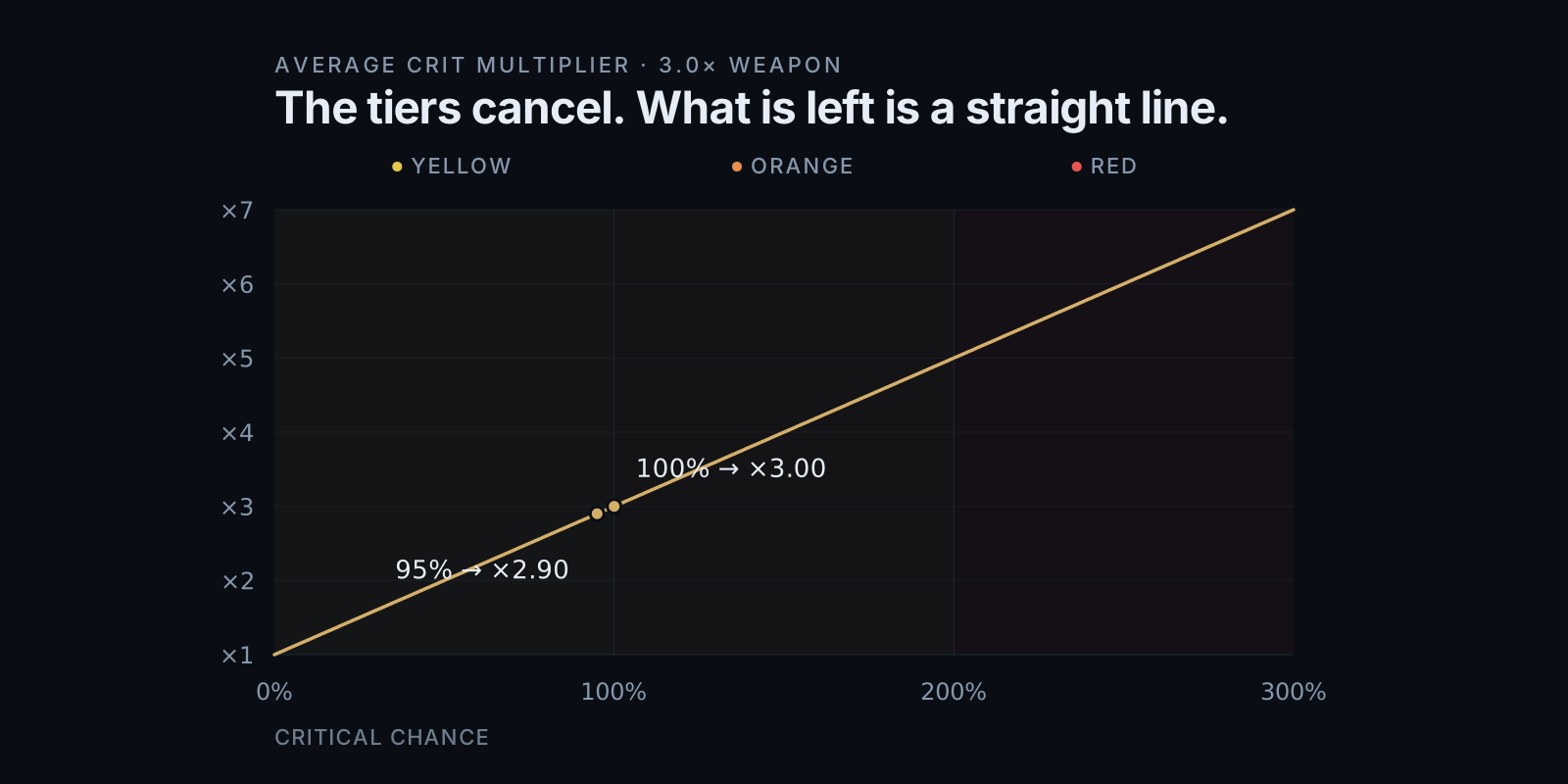
Yellow, orange and red crits look like tiers with thresholds. Work the average out and every tier cancels: one multiplication, no breakpoints, and a reason to stop chasing colours.
Critical hits are the part of Warframe’s damage model that looks the most complicated and turns out to be the simplest. There are tiers, there are colours, there is a threshold at 100% and another at 200% — and none of it survives being written down properly.
What comes out the other side is one multiplication with no breakpoints in it. That changes how you build.
How Warframe damage actually works places the critical layer in the pipeline and says what it does. This guide is the arithmetic underneath it.
Two numbers on the card
38%
Critical chance
How often a shot crits. Mods multiply it, and it can pass 100%.
3.0×
Critical multiplier
What a crit is worth when it lands. Three times the damage, not three times more.
Unmodded Rubico Prime. Everything below starts from these two.
The multiplier is the one people misread. 3.0× means the hit deals three times the damage, not three times more. A 100-damage shot that crits deals 300, not 400.
Critical chance mods are additive with each other and then multiply the base once, like every other percentage mod. Point Strike at +150% turns 38% into 38 × 2.5 = 95% — one mod, and the weapon is nearly always critting.
Where the naive reading breaks
The obvious model is a coin flip: 38% of the time you deal ×3, the rest of the time ×1. Average it out and you get 1.76.
That is correct, and it stops being correct at 100%.
Below 100%
Every shot is a coin flip. The average mixes ordinary hits with critical ones, and the arithmetic is the one everybody already does.
Above 100%
Every shot crits. There is no ordinary hit left for the surplus to convert — and yet the surplus is not wasted.
So what is critical chance doing once it passes 100%?
If the model were only a coin flip, crit chance past 100% would be worth nothing, and builds that stack it far past that point would be wasting mods. They are not.
The tiers
The surplus promotes a hit one tier higher. A weapon at 133% chance crits on every shot, and a third of those crit at the next tier up.
The tiers are named for the colour of the damage number, and the multiplier at tier n is:
Yellow
tier 1
×3.0
The multiplier on the card, as it is.
Orange
tier 2
×5.0
Past 100% chance.
Red
tier 3
×7.0
Past 200% chance.
tier n = 1 + n × (multiplier − 1)
Each tier adds the bonus again, not the whole multiplier. On a 3.0× weapon the bonus is +2, so the tiers run 3, 5, 7 — not 3, 6, 9. An orange crit is not double a yellow one.
And then it all cancels
A weapon between two tiers spends part of its shots on each, so its average is the two tiers mixed in proportion. Write that out, with n the tier you have reached and f the fraction past it:
average = [1 + n(m−1)](1−f) + [1 + (n+1)(m−1)]f
        = 1 + (m−1)[n(1−f) + (n+1)f]
        = 1 + (m−1)(n + f)
        = 1 + chance × (multiplier − 1)
The tier index disappears.
The average effective multiplier
average = 1 + chance × (multiplier − 1)
A straight line, from the first percent to the three-hundredth. No threshold, no breakpoint, no diminishing return. This is exact algebra, not an approximation that happens to fit.
The line, drawn
Here is the same statement as a picture. The coloured bands are the tiers, the dashed lines are the boundaries everyone builds around, and the line walks through both without noticing.
The numbers, from our own engine
| Critical chance | Tier reached | Average multiplier | Damage from 100 |
|---|---|---|---|
| 38% | yellow | ×1.76 | 176 |
| 95% | yellow | ×2.90 | 290 |
| 100% | orange | ×3.00 | 300 |
| 133% | orange | ×3.66 | 366 |
| 200% | red | ×5.00 | 500 |
| 300% | red | ×7.00 | 700 |
Look at the step from 95% to 100%. The colour changes, a tier boundary is crossed, and the number does nothing remarkable: +0.10, exactly what the previous five points of chance were worth.
Those figures come out of computeWeapon(), the same function that fills the build planner. They were read from it rather than worked out on paper.
What it means when you build
-
Crit chance past 100% is not wasted
A point above the line is worth precisely what a point below it was worth. Builds that commit fully to crit are not overshooting.
-
Chance and multiplier appear as a product
In
chance × (multiplier − 1), doubling either one doubles the bonus. Which to add is decided by what the weapon is short of, not by a rule — on a weapon with low base chance, chance is what is missing; on one that already crits every shot, the multiplier is. -
The colour is not a target
Building to "reach red" buys nothing by itself. The average only ever sees the chance and the multiplier; the colour is a consequence of where the chance landed, not a reward for landing there.
A worked example on the Rubico Prime, each step read from the engine:
| Build | Chance | Multiplier | Average |
|---|---|---|---|
| Bare | 38% | 3.00× | ×1.76 |
| + Point Strike | 95% | 3.00× | ×2.90 |
| + Vital Sense | 95% | 6.60× | ×6.32 |
Two mods, and the weapon’s average output is 3.6 times what it started at. Neither of them crossed a tier boundary.
Where it sits in the damage calculation
Damage per shot
base, mods, elements
× multishot
projectiles per trigger
× average crit
the line above
per trigger = per shot × multishot × average crit multiplier
The critical layer resolves last, on the total for one pull of the trigger. Which is why multishot and critical mods reinforce each other rather than compete: the crit multiplier is applied to the whole volley, including the extra projectiles multishot added.
Two things worth being honest about
The tier rule is an assumption
Our engine flags it as one — CRIT_TIERS.status = 'assumed' — because it is what the community established rather than something we measured. The planner applies it and labels it, which is the same treatment every unverified rule on this site gets.
An average is an average
No shot ever deals 1.76× damage. Shots deal ×1 or ×3, and 1.76 is what you collect over enough of them. The line describes the long run, not the number you watch come off an enemy — which is exactly why two players running the same build can come away describing different weapons.